
The Empty Cockpit
- runtime-infrastructure
- stateful-systems
- execution-semantics
- observability
- continuity
- runtime-inspection
- evidence-systems
- event-sourcing
- runtime-boundaries
- ai-native-runtime
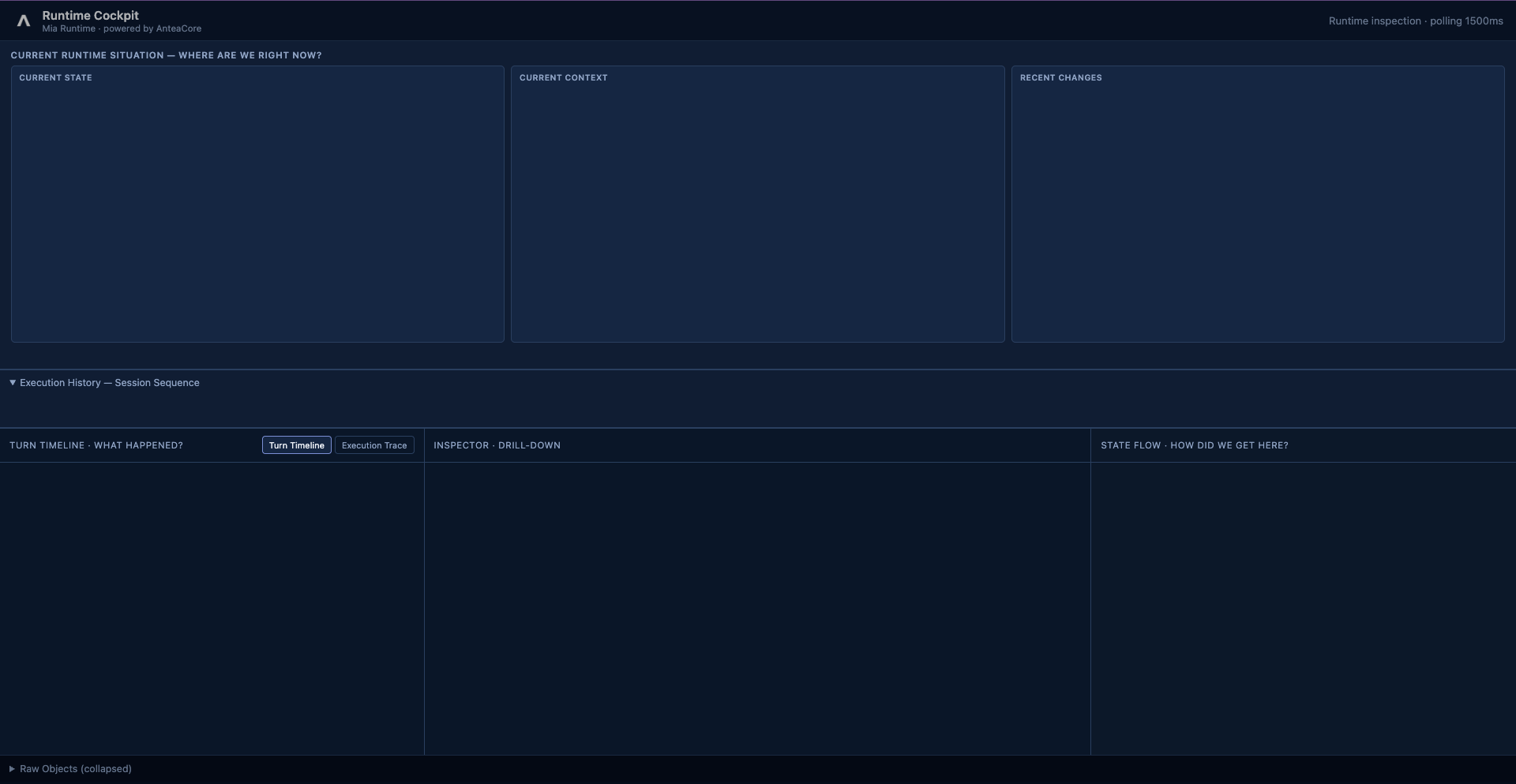
The first AnteaCore proving surface worth showing does not show an agent doing anything.
It shows a cockpit with no selected turn, no active transition report, no state flow, and no rendered explanation.
That is the point.
Most AI demos begin with activity. A prompt is entered. A response appears. A trace expands. Something looks alive.
But a stateful AI system does not become understandable because something happened. It becomes understandable when the system can explain where it is, how it got there, what changed, and what evidence supports the change.
That requires a different kind of interface.
Not a chat window.
Not a generic analytics dashboard.
Not a trace viewer.
A runtime inspection surface.
The Empty State Matters
An empty cockpit is honest.
If no turn transition exists, the system should not invent one. If no execution has occurred, the system should not pretend there is a story. If no state change has been committed, the system should not display activity just to make the interface feel alive.
This matters because AI systems are unusually good at producing plausible continuity. They can narrate, infer, summarize, and explain. But runtime infrastructure cannot be built on plausible continuity.
It has to be built on retained evidence.
The cockpit being empty is the first visible sign of that boundary.
The model may produce language.
The runtime must preserve truth.
What an AI-native Runtime Has To Show
The cockpit is organized around four surfaces.
Current Runtime Situation
This answers the question most debugging actually starts with:
Where are we right now?
Not what happened in the last message. Not what the model thinks is active. Not what the UI happens to have selected.
The current runtime situation is session-wide. It is derived from authoritative state, retained inspection evidence, folded context, and rebuilt runtime state.
It needs to show the system’s current position before asking the user to inspect a turn.
Execution History
This answers:
How did the session progress?
A stateful AI system is not just a sequence of messages. It is a sequence of interpreted intents, executions, committed events, blocked actions, retrievals, context updates, and state transitions.
Execution history gives the runtime a session map.
It is not the same thing as a chat transcript. A transcript records conversation. Execution history records runtime movement.
Turn Inspection
This answers:
What happened in this selected turn?
Turn inspection is intentionally scoped. Selecting a turn should affect the timeline, inspector, trace, state flow, and raw evidence for that turn.
It should not rewrite the current runtime situation.
That distinction matters. Without it, the cockpit becomes another latest-report viewer. It loses the ability to separate the state of the system from the artifact currently being inspected.
State Flow
This answers:
How did this turn change state?
The shape is simple:
Before State → Events Applied → Semantic Delta → After State
That structure is the difference between observing output and understanding mutation.
Events are truth-bearing evidence. Semantic deltas are human-facing meaning. State projections show before and after. The cockpit should not collapse those into one blob.
State change needs anatomy.
Raw Objects
This answers:
What is the underlying evidence?
Rendering can be wrong. Summaries can be incomplete. Human-facing labels can hide important details.
Raw objects remain the escape hatch.
Transition reports, event slices, state deltas, context deltas, references, raw payloads, and inspection records must remain available.
Understanding should never remove access to evidence.
Why This Is Not Just Observability
Observability tells you how a system behaved.
An AI-native runtime has to go further. It has to show how behavior relates to state, context, authority, evidence, and change over time.
Logs are not enough.
Traces are not enough.
A chat transcript is not enough.
A stateful AI system needs a way to answer:
What did the model propose? What did the runtime allow? What was blocked? What was read? What was mutated? What evidence was retained? What does the system believe is current now?
That is the difference between an AI interface and runtime infrastructure.
The Model Proposes. The Runtime Verifies.
The cockpit reflects a core AnteaCore principle:
Models propose. Systems verify.
The model may interpret language, infer intent, generate possibilities, or summarize context.
But the runtime is responsible for preserving state, constraining execution, retaining evidence, reconciling reality, and making change inspectable.
That distinction becomes more important as AI systems become more stateful.
A stateless answer can be judged in isolation.
A stateful system has memory, continuity, authority, and consequences. It can change what future turns mean. It can update context. It can mutate application state. It can build a history that later decisions depend on.
That kind of system needs more than model evaluation.
It needs runtime inspection.
What The Cockpit Does Not Solve Yet
This cockpit is an inspection surface for AnteaCore—not the product.
It currently proves the inspection shape for mutation turns. It can show the current runtime situation, session sequence, selected-turn inspection, state flow, and raw evidence.
The next gaps are already visible.
Blocked execution needs first-class visibility. A blocked turn has no state mutation, but it is still meaningful runtime behavior. The system should show the proposed intent, the epistemic failure, the reason execution did not proceed, and the fact that state remained unchanged.
Retrieval activity also needs its own inspection model. Retrieval does not mutate state, so it should not be forced into a mutation state-flow. It needs to show what was asked, what view was read, what result was returned, and whether context changed.
Those are not side features.
They are evidence that the cockpit is doing its job: revealing the next missing runtime surfaces.
The Artifact Is Empty Because The Category Is Early
The screenshot does not show intelligence.
It shows the space intelligence has to move through before it can be trusted.
Current situation. Execution history. Turn inspection. State flow. Raw evidence.
That is the minimum shape I currently believe is required to understand an AI-native runtime.
Not because the interface is finished.
Because the runtime is finally visible enough to show what is still missing.