
The System Knew What Happened. The Human Did Not.
- observability
- inspection
- runtime
- cockpit
- ai-infrastructure
The cockpit got worse every time it became more observable.
That was the part that made the least sense, because every added layer was technically correct. More traces helped. More state visibility helped. More context visibility helped. More verification helped. More evidence helped. Each improvement made the system more inspectable, and each improvement removed a real blind spot, but the cockpit still did not feel easier to use. It became richer, more complete, and more accurate, yet somehow it also became harder to understand.
The original assumption was simple: if an AI runtime becomes difficult to reason about, the system needs better observability. This is a natural assumption because it is how software teams have learned to survive complexity. When behavior becomes opaque, we add logs. When latency becomes mysterious, we add traces. When failures become hard to isolate, we add metrics. When state becomes difficult to inspect, we expose more of it. The modern software reflex is to treat confusion as a visibility problem.
That reflex is not wrong.
It is just incomplete.
That is when the problem changed shape.
The Cockpit Got Worse Every Time It Became More Observable
A sufficiently complex runtime can become perfectly observable and still remain unintelligible.
That distinction only became obvious after the system could already answer most of the technical questions. It could show what executed, what state changed, which events were emitted, which references were verified, which runtime phases occurred, and which evidence supported the transition. It could reconstruct state boundaries, explain confidence at the evidence layer, correlate execution to runtime traces, and expose enough raw detail for a developer to prove the system had not silently invented its own reality.
And still, when looking at the cockpit, the most important question remained strangely difficult to answer. What happened?
Not what emitted. Not what hashed. Not what verified. Not what trace ID linked to what span. What happened?
That question sounds less technical, which is why engineers often underestimate it, but it is actually the question that determines whether a system can be trusted by a human operator. A runtime may be able to expose every internal artifact it produced, and yet if those artifacts arrive as a pile of identifiers, nested JSON, generic summaries, and disconnected evidence panels, the human still has to rebuild the story manually.
At that point, the system has not created understanding.
It has delegated understanding to the operator.
This is the failure mode I did not expect.
The Real Bottleneck Was Translation
The cockpit did not fail because the runtime lacked evidence. It failed because evidence was being presented in the same shape the system used internally. That shape was useful for machines, useful for tests, useful for verification, and useful for debugging, but it was not the shape a human needed in order to reason quickly. The runtime was answering implementation questions when the operator was asking runtime questions.
There is a difference between a system that can show its work and a system that can explain its work.
Most AI infrastructure conversations still collapse those two ideas into the same bucket. They treat observability as the final visibility layer, as if a better trace, a richer log, or a deeper state viewer eventually becomes understanding through sheer density. But density is not understanding. Detail is not understanding. Evidence is not understanding. A thousand accurate facts can still be arranged in a way that forces the human to do the hardest part.
That became the architectural discovery.
Observability answers how the runtime operated.
Understanding answers what the operation meant.
Those are different layers.
The runtime may know that an input was received, an intent was derived, an execution path ran, state changed, context shifted, evidence verified, and telemetry linked. But if the cockpit presents those as separate blocks of data, the human has to mentally stitch together a turn narrative from system fragments. The operator becomes the renderer. The operator becomes the correlation engine. The operator becomes the final layer of runtime comprehension.
That is not acceptable if the system is expected to grow.
A stateful AI system is not only a model call with extra logs around it. It is a runtime carrying continuity, execution, evidence, and memory across time. Once that runtime begins to accumulate meaningful state, the cost of understanding a single turn becomes part of the system’s operational burden. If a human has to hunt through traces, reports, state deltas, context shifts, and raw evidence just to understand one mutation, then the system has not really become inspectable. It has only become exposed.
There is a difference.
Exposure Is Not Inspection
Exposure makes internal structures visible.
Inspection makes runtime behavior understandable.
That shift changed the cockpit.
The first version was organized around data categories. Execution lived in one area. Semantic changes lived somewhere else. Context changes had their own section. Evidence appeared as another block. Telemetry was separate. Raw infrastructure sat below everything like a giant machine-readable appendix. This was logical from the system’s perspective, but it was backward from the human’s perspective.
Humans do not inspect a turn by asking which subsystem produced which artifact.
They ask what happened first, what changed next, what the system believed, whether the evidence matched reality, and where to look if something feels wrong.
The cockpit only started becoming useful when the navigation model changed from data type to runtime narrative.
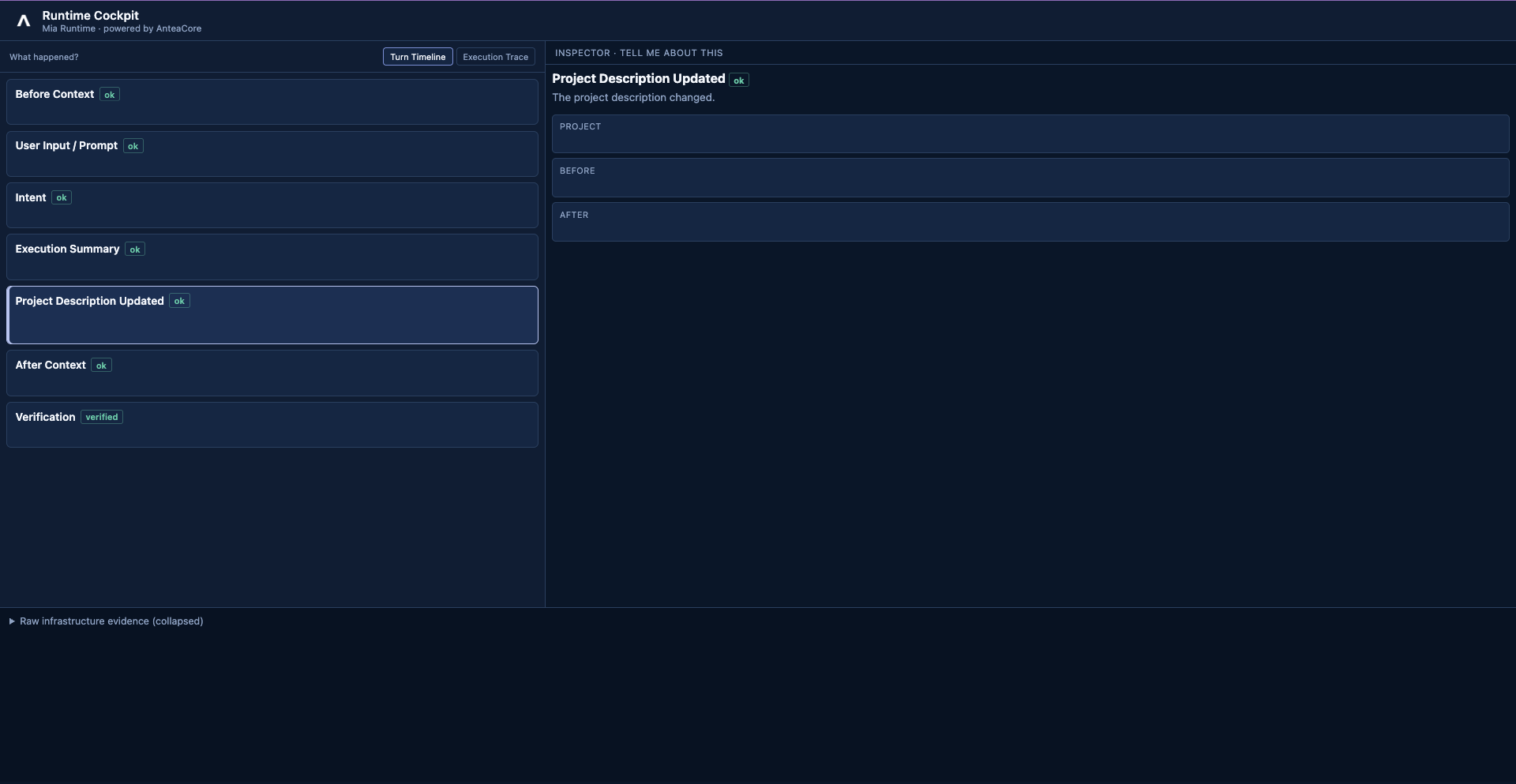
The turn needed a timeline. The execution needed a trace. The selected thing needed an inspector. Evidence needed to become contextual instead of floating below the page as a pile of raw proof. Human-readable information needed to appear first, and JSON needed to become the last resort rather than the default representation.
That sounds like a UI improvement, but it is really an architecture boundary.
The Proper Separation of Responsibilities
The runtime should preserve truth. The evidence layer should support verification. The understanding layer should translate what happened. The presentation layer should help a human navigate it.
When those responsibilities collapse, the result is predictable. Observability bleeds into UI. Verification output becomes prose. Raw evidence becomes the primary view. Telemetry becomes detached from the execution it proves. State references masquerade as understanding. The system becomes technically correct and practically exhausting. That is the trap.
It is easy to believe that more visibility will eventually become clarity, but at some point more visibility only creates a larger surface area for confusion. The missing layer is not another log or another trace. The missing layer is the translation between runtime evidence and human interpretation.
This matters beyond a cockpit.
As AI systems become more stateful, they will produce more internal evidence than humans can naturally consume. They will maintain context, mutate durable state, route through dynamic execution paths, and make decisions whose correctness depends on what happened before. The need for evidence will increase, but the need for understanding will increase faster.
The systems that only expose artifacts will feel powerful but unstable.
The systems that translate artifacts into inspectable runtime narratives will feel grounded because they are no longer asking the human to complete the runtime’s work.
That is the distinction I now care about.
Not whether an AI system can show me more.
Whether it can help me understand what its own evidence means.
The uncomfortable implication is that many teams may already have enough observability to know what their systems are doing, but not enough structure to understand what their systems are doing. They may keep adding logs, traces, dashboards, and metrics, believing the next layer of visibility will finally create confidence, when the real missing layer is somewhere else entirely.
The runtime knows what happened. The human does not.
That gap is not an observability problem.
It is an infrastructure problem hiding inside the user experience.
And once you see it, every AI dashboard starts looking different.